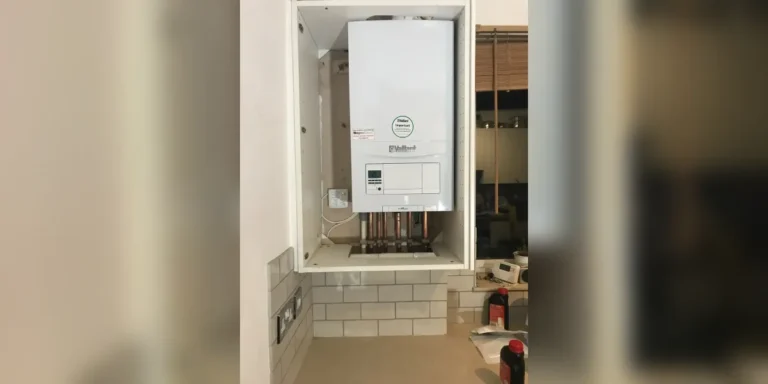
If the needle on your boiler pressure gauge has dropped into the red, or the boiler has locked out with a low pressure fault code, the heating and hot water usually stop with it. It is one of the most common reasons a combi or system boiler stops working when the heating goes back on in autumn.
A one-off drop is often something you can put right yourself in a few minutes. A boiler that keeps losing pressure is a different matter. That almost always means water is escaping from somewhere, and finding out where is a job for an engineer. This guide explains what the gauge should read, why pressure falls, how to top it up safely and the signs that it is time to call someone out.
What should my boiler pressure be?
Most sealed heating systems, which covers combi boilers and system boilers, should read between 1 and 1.5 bar when the heating is cold. Many gauges show this range in green. As the water heats up it expands, so the reading rising a little while the boiler is running is normal. Your boiler manual gives the exact figures for your model, and it is worth checking because they do vary between manufacturers.
If the cold reading falls below 1 bar, many boilers will refuse to fire and show a low pressure fault. Older open-vented systems, the type with a feed and expansion tank in the loft, do not have a pressure gauge and work differently, so this guide is aimed at sealed systems.
Why does a boiler lose pressure?
A sealed system is designed to hold its pressure. When it drops, water has left the system or the system is struggling to cope with expansion. These are the usual causes.
You have recently bled the radiators
Letting air out of a radiator also lets a little water out, so the pressure falls. This is expected and a single top-up normally sorts it. If you have been bleeding radiators because some of them are cold at the top, our guide to radiators that are cold at the top or bottom explains what the cold patch is telling you.
A small leak somewhere on the system
Even a slow drip from a radiator valve or a pipe joint is enough to pull the pressure down over a few days. Check around radiator valves, visible pipework and underneath the boiler. Look for drips, damp patches on floors or ceilings, rust marks and white or green crusting on fittings, which shows where water has been weeping and drying. Leaks under floorboards or inside walls are harder to spot and often need tracing by an engineer.
The pressure relief valve is letting water out
Every sealed system has a pressure relief valve that opens if the pressure gets too high. It usually discharges through a small copper pipe that runs through the outside wall near the boiler. If that pipe is dripping, or you can see water marks on the wall below it, the valve has been releasing water. That points either to a worn valve or to the system over-pressurising when it heats up.
The expansion vessel has lost its charge
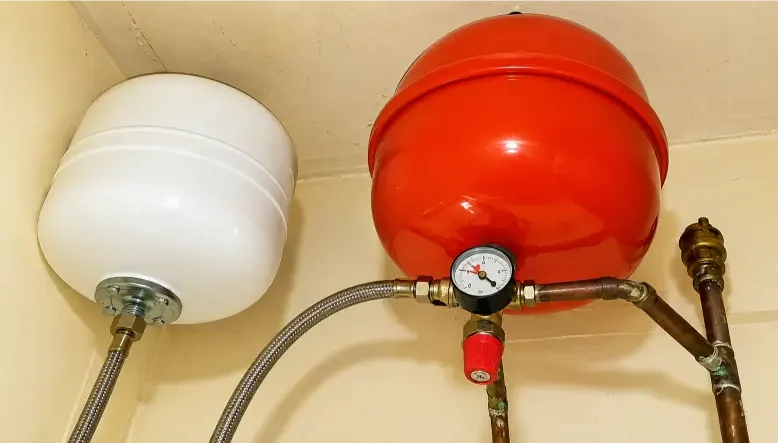
The expansion vessel is a small tank, inside the boiler on most combis, that absorbs the extra volume of water as it heats. It relies on an air charge to do this. When that charge drops, the pressure shoots up every time the heating runs, the relief valve opens to protect the system, and the pressure then falls well below normal once everything cools down. A gauge that climbs high when hot and sinks low when cold is a classic sign. Recharging or replacing the vessel is an engineer’s job.
A fault inside the boiler
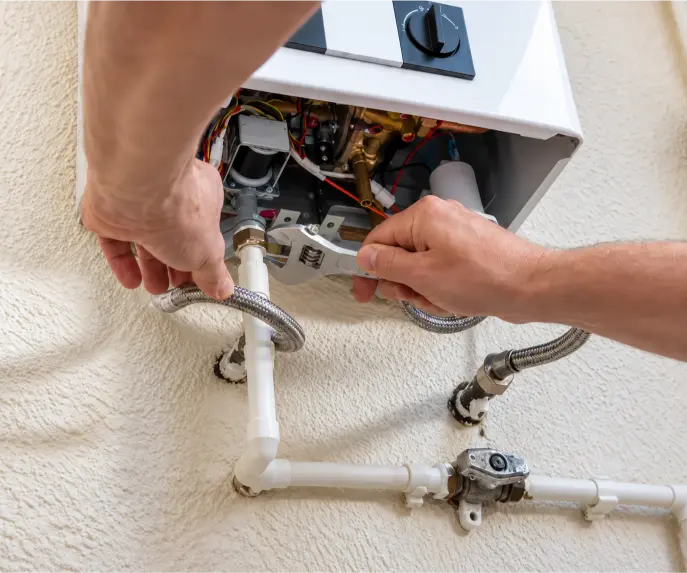
Water can also escape from inside the boiler itself, for example from a failed seal, a pump or an internal component. Do not remove the boiler casing to look. Work on gas appliances must be carried out by a Gas Safe registered engineer, and the inside of the boiler is not a DIY area.
How to repressurise a combi or system boiler
Always read your boiler manual first, because filling arrangements differ. Many boilers use an external filling loop, a braided silver hose under the boiler with a valve at each end. Some Worcester Bosch models use an internal filling key, and other brands use a built-in lever or tap. The general process looks like this:
- Turn the heating off and let the system cool. You want to read the gauge cold, otherwise you will under-fill.
- Find the filling loop or filling key. On an external loop, check both ends are connected securely.
- Open the valves slowly. Open one valve fully, then turn the second gradually. You will hear water flowing into the system.
- Watch the gauge. Close the valves when the needle reaches around 1 to 1.5 bar, or the figure in your manual.
- Close both valves fully. If your loop is the removable type, disconnect it and catch any drips with a cloth. A loop left connected with a valve not quite closed can slowly over-fill the system.
- Reset the boiler if needed and check that the heating and hot water come back on.
If you overshoot and the gauge reads too high, bleeding a radiator for a few seconds will bring it back down.
When a top-up is not enough
Topping up treats the symptom, not the cause. It is time to book a boiler repair if you notice any of the following:
- You are topping the boiler up every few days or weeks.
- The pressure rises well above the normal range when the heating is on.
- Water is dripping from the pressure relief pipe outside.
- There is water underneath or inside the boiler.
- You have damp patches or stains on ceilings or floors.
- The low pressure fault code keeps coming back.
There is another reason not to keep refilling a leaking system. Every top-up brings in fresh mains water containing dissolved oxygen and dilutes the corrosion inhibitor in the system. Over time that can speed up rust and sludge inside radiators, which leads to its own problems with cold spots and poor circulation.
If the leak is on pipework rather than the boiler, our emergency pipe repair service covers leaking joints, valves and damaged pipes.
If you smell gas
Low boiler pressure is a water problem, not a gas problem. If you ever smell gas, do not operate electrical switches, open doors and windows, turn off the gas at the meter if you can do so safely, leave the property and call the National Gas Emergency Service on 0800 111 999.
How VMV Plumbing & Heating can help
Our Gas Safe registered engineers (Gas Safe Register No. 594654) trace pressure loss on combi and system boilers across Milton Keynes, Bletchley, Newport Pagnell, Wolverton and the surrounding towns. We check the expansion vessel, pressure relief valve, boiler internals and the wider system to find where the water is going, then explain the repair options. An annual boiler service is also a good opportunity to have the system pressure and expansion vessel looked at before winter.
Boiler keeps losing pressure? Call us on 07902 743538 (24/7 call out) or request a free quote online.
Frequently asked questions
Is low boiler pressure dangerous?
Low pressure on its own usually just stops the boiler working, because modern boilers lock out to protect themselves. The bigger concern is the cause. A leak can damage ceilings, floors and electrics if it is left, so it is worth finding out why the pressure is falling.
How often should I need to top up my boiler?
A healthy sealed system should hold its pressure for long periods. An occasional top-up after bleeding radiators is normal. Needing to refill regularly means there is a fault that should be investigated.
Can I fix a leaking boiler myself?
You can safely repressurise the system and check visible pipework and radiator valves. Anything inside the boiler casing should be left to a Gas Safe registered engineer.
Why does my boiler pressure go up when the heating is on?
A small rise is normal because water expands as it heats. A large rise, especially if it is followed by water from the relief pipe and a low reading when cold, usually points to an expansion vessel that has lost its charge.