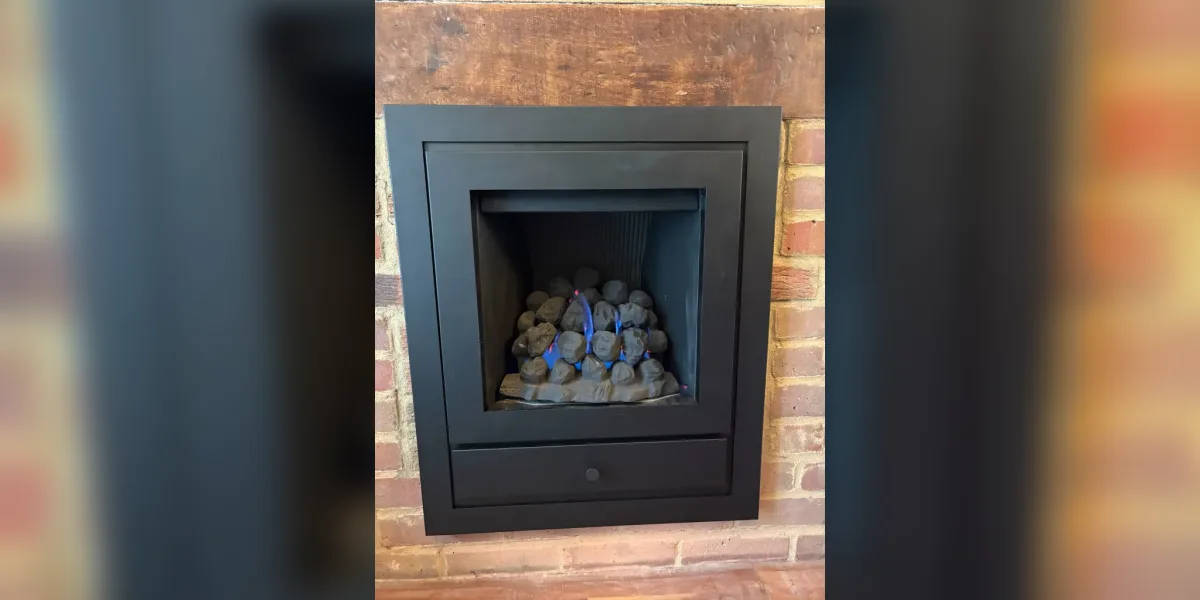
A gas fire gives a living room a focal point and instant, controllable heat on cold evenings. The type you can have, though, depends less on the look you like and more on one question: how will the fumes leave the room? That is decided by your chimney, your walls and the size of the room.
This guide explains the main types of gas fire, which homes each one suits, what affects the cost, and the safety checks that come with any gas fire installation.
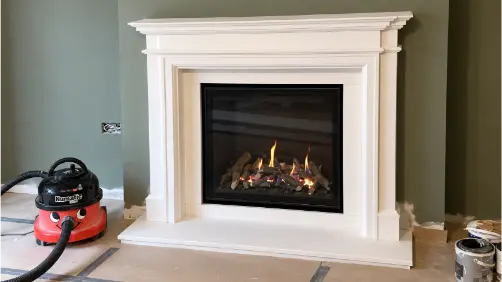
Conventional flue gas fires
A conventional (open flue) fire sends its fumes up an existing chimney or a pre-cast flue built into the wall. Older brick-built homes often have a Class 1 chimney. Many newer homes have a Class 2 pre-cast flue, which is narrower and only suits fires designed for it.
Conventional flue fires include inset fires, decorative fuel effect fires and many traditional outset models. They draw combustion air from the room, so the room may need a permanent air vent, depending on the fire’s heat input.
Before fitting one
The chimney or flue must be checked and, where needed, swept. The engineer carries out a flue flow test before fitting and a spillage test after fitting, to prove the fumes go up the flue and not back into the room. A chimney that has not been used for years may need a liner.
Balanced flue gas fires
A balanced flue fire is room sealed. A short twin wall pipe runs through an outside wall. Fresh air is drawn in through one part and fumes leave through the other. Because the glass front is sealed, the fire does not take air from the room.
Balanced flue fires suit homes with no chimney, which includes many new builds and extensions. They are also very efficient, since less heat is lost up a flue. The catch is location: the fire must sit on or very close to an outside wall, and the terminal outside must keep set distances from windows, doors and boundaries.
Power flue gas fires
A power flue fire uses a small fan to push fumes out through a pipe to an outside wall. This lets the fire sit further from the wall than a balanced flue fire would allow. It needs an electrical supply, and you may hear the fan running. It is a useful option when a chimney is blocked or the wall you want the fire on is not an outside wall.
Flueless gas fires
A flueless fire has no chimney or pipe. It burns gas through a catalytic converter, which turns most carbon monoxide into carbon dioxide and water vapour. That makes it the most flexible type, since it can go on almost any wall.
It also comes with the strictest rules. A flueless fire needs:
- a minimum room volume set by the manufacturer;
- a permanent air vent to the outside, sized to the manufacturer’s instructions;
- a window or other opening that can be opened;
- a suitable room, since manufacturers do not permit them in bedrooms, bathrooms or small rooms.
Because the water vapour stays in the room, a flueless fire can add to condensation. It should be serviced every year, and the catalytic converter must be kept in good condition.
Which type of gas fire suits your home?
| Your home | Usually suits |
|---|---|
| Working brick chimney | Conventional flue, inset or decorative fuel effect |
| Pre-cast flue in a newer house | Conventional flue fire approved for Class 2 flues |
| No chimney, fire on an outside wall | Balanced flue |
| No chimney, fire away from an outside wall | Power flue |
| No chimney or wall route, large living room | Flueless, if the room meets the rules |
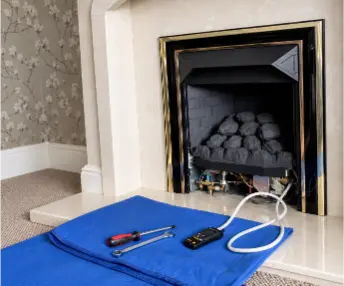
How much does a gas fire installation cost?
The cost depends far more on the flue and the gas supply than on the fire itself. As a general idea, swapping an old fire for a new one of the same type, on a chimney that is already in good order, is usually the simplest and most affordable job. The price goes up when the work includes:
- sweeping, repairing or lining a chimney;
- cutting a new balanced flue or power flue through an outside wall;
- running a new gas supply to a fire position that has never had one;
- fitting a permanent air vent;
- a more expensive fire, such as a high efficiency glass fronted model.
Because every fireplace is different, we do not publish fixed prices. Viktor, who runs VMV Plumbing & Heating, will talk you through the options and give you a price over the phone. Call 07902 743538, or send your details and we will call you back.
Gas fire safety and the regulations
Under the Gas Safety (Installation and Use) Regulations 1998, anyone fitting a gas fire for payment must be on the Gas Safe Register. The engineer must follow the manufacturer’s instructions and the relevant British Standards for flues and ventilation.
Since October 2022, Approved Document J of the Building Regulations in England has required a carbon monoxide alarm in the room whenever a new or replacement fixed combustion appliance, such as a gas fire, is installed. If you rent the property out, the Smoke and Carbon Monoxide Alarm Regulations also require alarms in rooms with a fixed combustion appliance. Our guide to landlord gas safety responsibilities covers that in more detail, and a gas fire in a rented home must be included in the annual check.
If you smell gas, or the fire’s flames burn yellow or lazy, or there is soot around the fire, stop using it. Open the windows and call the National Gas Emergency Service on 0800 111 999.
What happens on a gas fire installation
- Survey. We check the chimney or flue route, the room size, the ventilation and the gas supply.
- Quote. You get a written quote covering the fire, the flue work and any gas pipe changes.
- Fitting. The gas supply is run to the fire, the flue or terminal is fitted, and any vent is installed.
- Testing. We carry out gas tightness, flue flow and spillage tests, set the burner pressure and fit a carbon monoxide alarm.
- Paperwork. The job is notified to Building Control through the Gas Safe Register, and you get your compliance certificate.
Gas fire installation with VMV
VMV Plumbing & Heating has been fitting gas fires since 2013 and is Gas Safe registered (594654). If the gas supply needs extending to a new fire position, we handle that too through our gas pipe installation service. See our gas fire installation page, or book a gas safety inspection if you have an existing fire that needs checking.
A gas fire works well alongside your central heating rather than instead of it. If your boiler is getting old, our guide to combi vs system boilers explains which type to choose next, and how often a boiler should be serviced covers why the fire and boiler can be serviced on the same visit.
Frequently asked questions
Can you install a gas fire without a chimney?
Yes. A balanced flue, power flue or flueless fire can all be fitted without a chimney. The right one depends on where the outside walls are and how big the room is.
Are flueless gas fires safe?
They are safe when fitted correctly in a suitable room with the required ventilation, serviced every year and used as the manufacturer intends. They are not suitable for bedrooms, bathrooms or small rooms.
Does a gas fire need an air vent?
It depends on the type. Balanced flue and power flue fires usually need no extra vent. Open flue fires above a certain heat input, decorative fuel effect fires and flueless fires all need a permanent vent. The manufacturer’s instructions and the British Standard set the size.
How often should a gas fire be serviced?
Every year. A service checks the burner, the flue or catalytic converter, the ventilation and the safety devices.
Can I fit a gas fire myself?
No. Gas fire installation should always be done by a Gas Safe registered engineer. A badly fitted fire or a blocked flue can leak carbon monoxide, which you cannot see or smell.